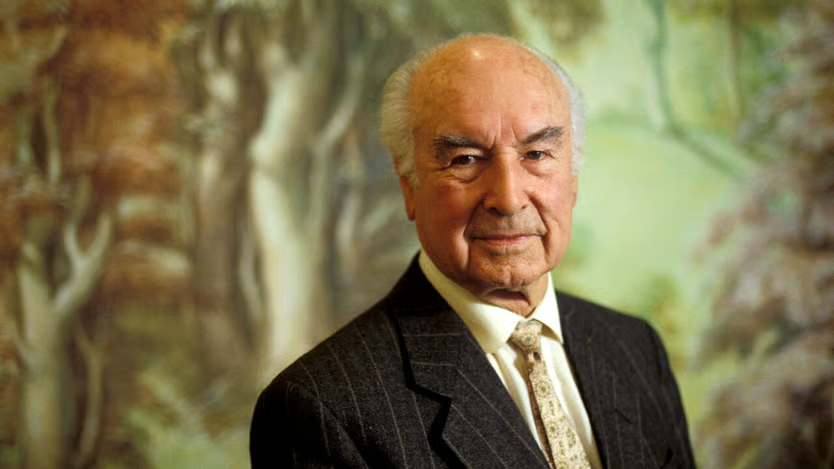
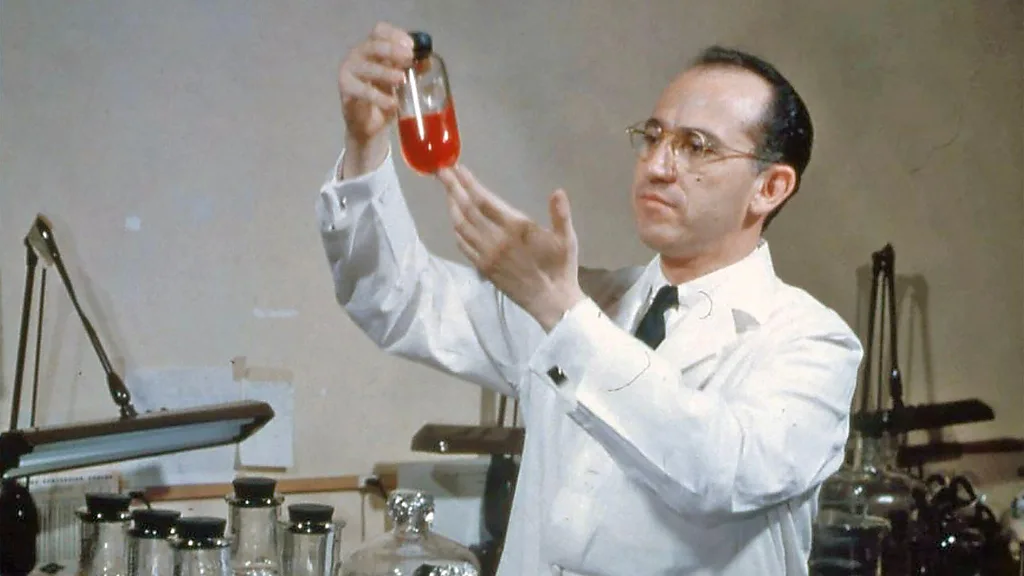
In April 1955, a medical breakthrough transformed global public health when Jonas Salk announced that his polio vaccine was safe and effective. At a time when Polio terrified families across the world, his discovery marked a turning point that would save millions of lives.
Polio was one of the most feared diseases of the 20th century. Outbreaks paralysed thousands, especially children, leaving many dependent on iron lungs to breathe. The scale of the crisis was overwhelming, with tens of thousands of cases reported annually in countries like the United States.
Salk approached the problem differently from many of his contemporaries. While others, including Albert Sabin, focused on developing a weakened live virus, Salk pursued a vaccine using a killed virus. His method aimed to safely trigger immunity without risking infection.
Working out of a lab in Pittsburgh, backed by the March of Dimes, Salk and his team moved with unusual speed. Their progress was driven by urgency as much as science, as the world waited for a solution to a disease that had no cure.
In a striking display of confidence, Salk tested the vaccine on himself, his wife, and his children before moving to large-scale trials. The results were groundbreaking. In 1954, one of the largest medical trials in history began, involving nearly two million children. A year later, the results confirmed what many had hoped for: the vaccine worked.
The announcement triggered global relief. Infection rates dropped dramatically within a year, and within a decade, polio had been nearly eliminated in the United States.
Yet, what truly defined Salk’s legacy was not just the discovery, but his decision not to patent it. When asked who owned the vaccine, he famously responded that it belonged to the people, comparing it to something as universal as the sun. This ensured that the vaccine could be distributed widely and affordably, accelerating its global impact.
Salk later established the Salk Institute, envisioning it as a space for scientific creativity and collaboration. Meanwhile, Sabin’s oral vaccine complemented Salk’s work, making mass immunisation even more accessible.
The story of the polio vaccine is not just about scientific achievement. It is about urgency, collaboration, and a rare moment when innovation was guided by public good over personal gain.
More than seven decades later, Jonas Salk’s breakthrough remains one of the clearest examples of how science, when driven by purpose, can reshape the course of human history.