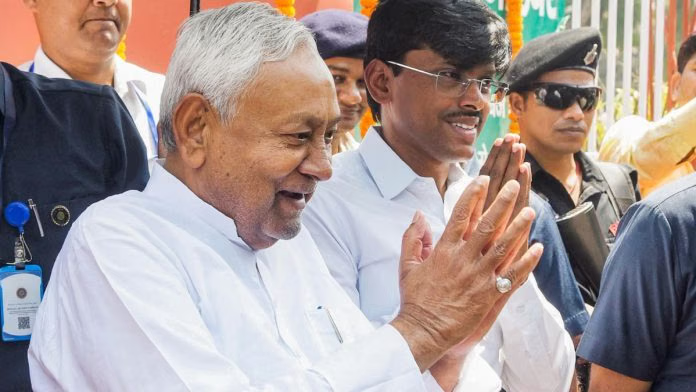
As Nitish Kumar stepped away from office, the moment carried an unusual emotional weight in Bihar. Senior political leaders, rarely seen displaying sentiment in public, were moved to tears. It was not just a farewell. It marked the closing of a political era that reshaped the state’s identity while leaving behind unresolved questions.
Nitish’s journey as chief minister began in earnest on 24 November 2005, when he assumed office for a full term after years of political churn. At the time, Bihar was widely perceived as struggling with weak governance, poor infrastructure, and fragile law and order. His early years focused on reversing that image.
Over the next two decades, Bihar saw visible changes. Roads expanded, electricity access improved, and governance acquired a sense of structure that had been missing. The economy picked up pace, recovering from stagnation associated with the earlier period under Lalu Prasad Yadav. For many, Nitish became the face of stability and administrative intent.
Allies and observers often credit him with restoring public confidence. K. C. Tyagi, a long-time associate, described those early years as a turning point when Bihar began to believe in its own recovery. Leaders from the Bharatiya Janata Party also acknowledged that his governance created opportunities where there had once been uncertainty.
A defining feature of Nitish’s politics was his outreach to the Extremely Backward Classes, broadening the state’s social and political base. His government later attempted to expand caste-based reservations to 65 percent following a caste survey, although the decision was struck down by the Patna High Court. Still, the effort reflected his long-standing emphasis on social representation.
Several welfare initiatives became closely associated with his tenure. The cycle scheme for schoolgirls improved access to education, while reservations for women in panchayats bodies strengthened grassroots participation. The Jeevika programme helped expand self-help groups, especially among rural women. Prohibition, introduced in 2016, gained support among sections of society but also created new challenges, including illegal trade and loss of state revenue.
Despite these interventions, Nitish’s political identity remained complex. He took oath as chief minister ten times and shifted alliances repeatedly, aligning at different points with both the Bharatiya Janata Party and the Indian National Congress. This adaptability kept him at the centre of power but also earned him the label “Paltu Ram,” reflecting frequent changes in political stance.
On governance, his record shows both progress and limitation. Law and order improved through stricter policing and faster judicial processes, and infrastructure saw steady growth. Yet, deeper structural issues remain. Bihar continues to rank low on human development indicators, with challenges in education, employment, and migration. Many young people still leave the state in search of better opportunities.
Critics argue that while surface-level improvements are visible, systemic problems persist. Concerns around corruption, administrative inefficiency, and crimes against women continue to shape public discourse.
Nitish Kumar’s legacy, then, resists simple conclusions. He redefined governance expectations in Bihar and altered its political landscape, yet could not fully bridge the gap between reform and long-term transformation.
As he exits the stage, Bihar stands at a crossroads, carrying forward both the gains of stability and the weight of unfinished change.