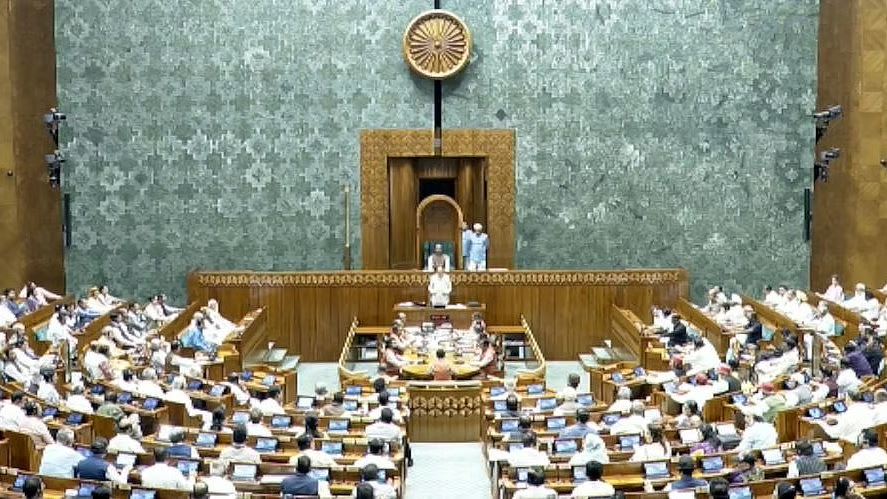
In a rare parliamentary reversal, the government led by Narendra Modi faced its first defeat on a constitutional amendment in over a decade, after a high-stakes bill failed to secure the required majority in the Lok Sabha.
The proposed amendment, which sought to expand the strength of the House and enable delimitation to implement women’s reservation, fell short despite securing 298 votes in favour against 230 opposed. The numbers did not meet the two-thirds threshold required for constitutional changes.
Announcing the result, Lok Sabha Speaker Om Birla confirmed that the bill could not pass as it failed to gather sufficient support among members present and voting. The Constitution (131st Amendment) Bill, 2026 aimed to redraw parliamentary representation based on updated population data following the next Census.
The bill ran into strong resistance from Opposition parties, including the Indian National Congress, Trinamool Congress, Dravida Munnetra Kazhagam, and the Samajwadi Party. Their central concern was delimitation, with fears that population-based seat redistribution could give disproportionate influence to a few larger states.
For the Opposition, the issue was not outright rejection of women’s reservation, but the conditions tied to its implementation. Several leaders argued that without safeguards, the exercise could reshape political balance in ways that disadvantage certain regions.
Reacting to the outcome, Union Minister Kiren Rijiju described the failure as unfortunate, framing the bill as a significant reform that lacked bipartisan backing. He indicated that two related bills would also be set aside following the defeat.
In the hours leading up to the vote, Prime Minister Modi had urged Opposition members to support the legislation, appealing to a broader sentiment around women’s representation. The debate, however, quickly evolved into a wider political confrontation.
Union Home Minister Amit Shah, speaking in the House, accused Opposition parties of obstructing progress through conditional support and political hesitation. He argued that delays in delimitation had already created disparities in representation, with some constituencies carrying vastly different population sizes.
At the heart of the disagreement lies delimitation, a process that redraws electoral boundaries based on population changes. The exercise has been frozen for decades, a decision rooted in policies dating back to the 1970s under former Prime Minister Indira Gandhi.
The government maintains that lifting this freeze is essential to ensure fair representation and to operationalise the women’s reservation framework. Critics, however, view the timing and structure of the proposal with caution, arguing that it could alter the federal balance.
Shah also addressed concerns around delays in conducting the Census, attributing them to disruptions caused by the COVID-19 pandemic and subsequent policy decisions, including the inclusion of caste data.
Beyond the numbers, the bill’s failure signals a shift in parliamentary dynamics. It reflects a moment where Opposition unity was able to block a major legislative push, even as the government framed the proposal as a step toward structural reform.
The debate also exposed deeper tensions around representation, federal balance, and the sequencing of electoral reforms. Issues like women’s reservation, caste census, and regional equity have now become tightly intertwined in the political discourse.
For the Modi government, the setback is more symbolic than numerical. It highlights the limits of legislative momentum when consensus is absent. For the Opposition, it marks a rare instance of coordinated resistance in Parliament.
What happens next will depend on whether the government revisits the proposal with modifications or continues with its current approach. Either way, the episode has added a new layer of complexity to India’s evolving political landscape.